Article by Amanda Dayton
Editor’s Note: In March of 2025, the Town Council majority, Mayor Bertaut and Council Members Ben Nett, Carol Luke, and Susan Khalil, began a series of actions to end formal town support of the Purcellville Main Street Program. In June of 2025, the same majority passed a budget that eliminated the town’s dedicated economic development employee and further reduced budget priority for planning and economic development initiatives and staffing.
To this day, multiple Town Council members fail to see why Main Street programs matter and how they can benefit the town. Let’s take a walk back through our history to understand.
Long before shopping centers, highways, and big-box retailers reshaped America, Main Street was where commerce happened. For generations, America’s downtowns served as the economic, cultural, and civic heart of their communities.
In Purcellville, our historic Main Street is centered at the corner of 21st and Main, with the original town growing outwards from this intersection. This historic area is where farmers gathered to load their crops on trains bound for Washington. It is where the first homes and businesses were built.
Following the expansion of the national interstate highway system, many small town businesses moved out of the historic downtown areas and into shopping strips and mega-malls, often decimating what was once vibrant town centers.
Recognizing this trend, the National Trust for Historic Preservation launched the National Main Street Center in 1980, creating the program that is now known as “Main Street America”. Rather than relying on demolition and large-scale development, the program focused on revitalizing existing downtowns through a careful balance of historic preservation, economic development, design improvements, business recruitment, and community engagement.
A Proven Economic Development Strategy
Today, Main Street America is widely recognized as one of the most successful place-based economic development programs in the country.
Since 1980, communities participating in the Main Street program have generated:
- More than $124 billion in public and private investment
- 852,000+ net new jobs
- 188,000+ net new businesses
- 356,000 historic buildings rehabilitated
- Over 41 million volunteer hours invested into local communities.
Even more impressive is the return on investment.
In 2025, for every $1 invested in operating a Main Street program, communities attracted an average of $23.13 in new downtown investment. That is an extraordinary return on investment, especially in a town where every dollar matters. (www.mainstreet.org)
Rather than subsidizing endless outward expansion, Main Street communities focus on making better use of infrastructure that already exists—roads, sidewalks, utilities, historic buildings, and public spaces.
That approach strengthens tax revenue while preserving the unique identity that makes communities attractive to residents, visitors, and entrepreneurs alike.
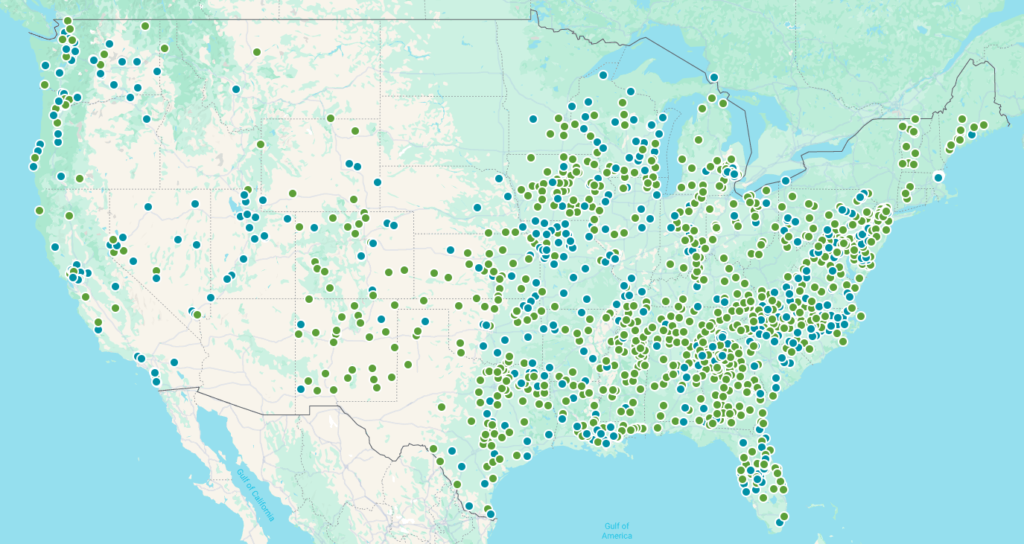
Communities accredited by (green) or affiliated with (blue) the Main Street America program.
Virginia Has Seen the Same Success
Virginia embraced the Main Street approach in 1985 through the Virginia Main Street Program administered by the Department of Housing and Community Development.
Over the past four decades, Virginia communities have experienced remarkable results.
Since the program began, Virginia Main Street communities have:
- Helped open or expand 8,624 businesses
- Created 28,451 jobs
- Generated more than $2.8 billion in public and private investment.
These successes are not limited to large cities.
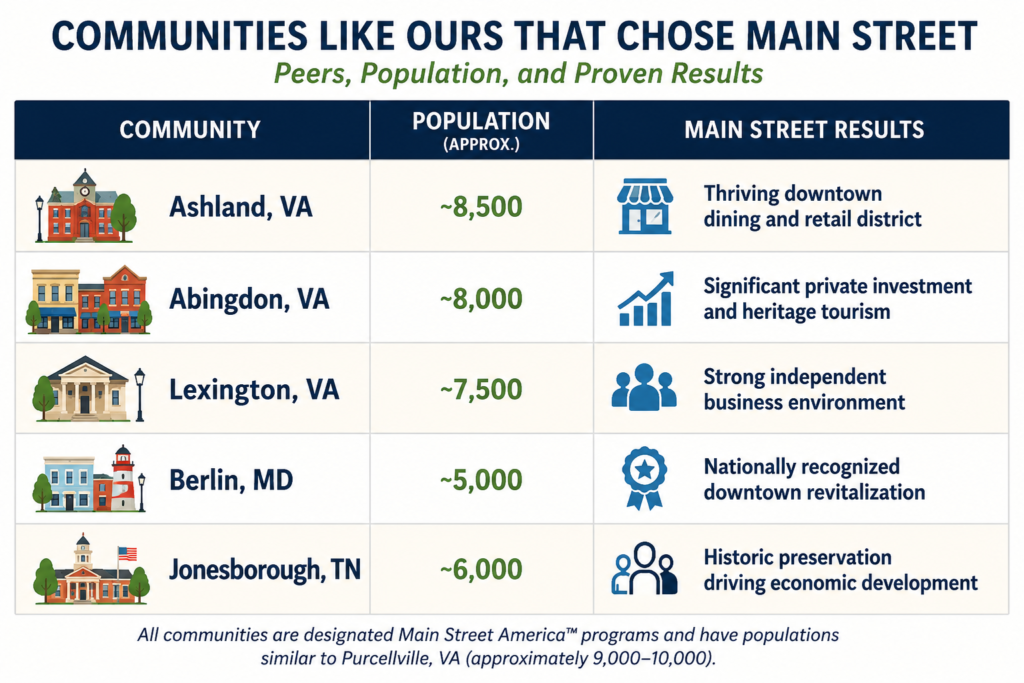
Communities across Virginia—including towns similar in size to Purcellville—have used the Main Street model to fill vacant storefronts, attract independent businesses, restore historic buildings, increase tourism, improve walkability, and grow their local tax base without sacrificing their historic character.
Redevelopment Beats Endless Sprawl
Healthy communities do not simply grow outward—they grow inward as well.
When investment flows only to the edges of town, communities often experience what planners call urban sprawl: new commercial corridors, chain restaurants, and expanding development patterns that require additional roads, utilities, and public infrastructure while older commercial districts decline.
Ironically, Purcellville has seen this significant expansion of mainstream commercial development under the leadership of the candidates who have most vocally advocated “slow growth” policies.
Over the past several years, much of Purcellville’s commercial growth has come in the form of national and regional chain businesses (IHOP, Dunkin Donuts, Chipotle, Panera, Sherwin Williams, Manhattan Pizza, and Dollar Tree to name a few). These businesses bring jobs, services, and investment to our community, and they are an important part of a healthy local economy. However, when the majority of new commercial development consists of businesses backed by large corporate resources, it raises an important question to ask: Why aren’t we seeing more locally owned businesses taking root or expanding? At the same time, we must analyze why local businesses such as Nest & Nook, Executive Cleaners, Petite LouLou, Gringo Gordo, and Dragon Hops are closing or moving away (just to name a few of the most recent closures).
Independent businesses face challenges that large corporations often do not. They typically have less access to capital, fewer financial reserves, and greater sensitivity to rising construction costs, lengthy approval processes, regulatory uncertainty, and infrastructure limitations. When the economic environment becomes difficult or unpredictable, national chains often remain capable of moving forward while local entrepreneurs choose not to invest—or simply cannot. While these business closures might not be directly related to a negative business climate created by town council actions, such an environment certainly doesn’t help prevent such events.
A thriving Main Street depends on lowering barriers for those local entrepreneurs. Successful communities are built by the small business owner opening their first restaurant, boutique, bakery, bookstore, or professional office—not solely by companies with national development teams and corporate financing. Communities that intentionally create a predictable, business-friendly environment attract both local investment and outside investment, resulting in a more diverse, resilient economy.
Main Street revitalization also helps to bridge the economic challenges small businesses face. By offering grants and incentives to restore historic properties, these programs help level the playing field between the costly restorations of historic buildings and the option to build new elsewhere.
Instead of abandoning existing infrastructure, communities reinvest in their existing structures. Buildings are restored rather than demolished. Vacant storefronts become new businesses. Public spaces become destinations. Local entrepreneurs are given an environment where success is much more achievable.
And this impact doesn’t solely impact the downtown historic corridor. Purcellville Main Street activities benefit the entire community, by creating relationships between businesses, attracting tourism dollars, and assisting to create the vibrant, small town feel that all of us desire.
This creates a more balanced pattern of development—one that protects community identity while encouraging sustainable economic growth.
Purcellville Is at a Crossroads
Today, many residents see vacant storefronts, underutilized buildings, aging infrastructure, and properties that have remained stagnant for years.
While investment has flowed to new commercial corridors, portions of our historic downtown and along Main Street west of Maple Avenue continue to struggle with blight and deferred redevelopment. Current policy decisions have turned away from restorative efforts and disincentivized investment in our historic district.
The consistent messaging from the “slow growth” camp is that restoration is someone else’s responsibility. I don’t believe this. I believe that it is a community’s responsibility to create a plan and vision for its future and to actively engage in that future. According to Town tax records, one restored downtown property saw its annual real estate tax assessment increase from approximately $3,000 to nearly $14,000. This is a tangible financial gain for our community. Increasing property values of our commercial community means reducing the financial burdens on our residents, funding programs and public services that improve quality of life and support local businesses, and strengthens the Town’s bottom line.
Our downtown should not simply survive because it is historic – It should thrive because it remains the economic and cultural center of our community.
Successful communities understand that economic development doesn’t just mean growth, but also a commitment to supporting our existing business infrastructure.
The Path Forward is Clear
The Main Street initiative is about far more than preserving historic buildings. It is about creating a place where people want to invest, work, shop, dine, and gather. It is about supporting the businesses that have already chosen to invest in Purcellville while creating an environment that encourages new local entrepreneurs to do the same.
It is about strengthening our local economy through reinvestment rather than neglect. Every restored storefront, every renovated historic building, and every successful small business adds value to our community. Those investments increase property values, expand the commercial tax base, and reinforce the relationships between local businesses, residents, nonprofits, and civic organizations that make small towns like Purcellville unique.
Purcellville possesses everything needed to become one of Virginia’s premier historic downtowns: a rich history, distinctive architecture, dedicated entrepreneurs, engaged residents, and a community that values its heritage. What we need now is a shared commitment to invest in those strengths.
The question is no longer whether the Main Street approach works. Decades of experience across Virginia and the nation have answered that.
The real question is whether we are willing to invest in the heart of our own community before opportunities are lost and decline becomes increasingly difficult to reverse.
Every thriving community reaches a defining moment when it must choose between investing in its future or simply managing its decline. Purcellville has reached that moment. The path forward is clear. The only question that remains is whether we have the vision and the resolve to take it.
Amanda Dayton is the President of the Purcellville Main Street organization. She is the founder and owner of the Enhanced Beauty and Wellness Clinic in downtown Purcellville and has been a dedicated member of the Purcellville business community for nearly 10 years. Passionate about holistic wellness, she brings valuable insight to the Main Street initiative. In her free time, she enjoys time with her husband, three kids, and their animals on their farm near Purcellville. She is eager to support local businesses and help maintain downtown Purcellville’s charm and vitality.