
When the Constitution Becomes Inconvenient
By Stephanie Marut, Purcellville Resident
Editor’s Note (10/19/2026): Following some feedback from community members, this article has been amended by the author to correct references to legal precedent and court cases.
The original reference to Acosta v Costa Mesa has been replaced with White v City of Norwalk. We apologize for any incorrect references that were made, but standby the original arguments made regarding our position on the legality of the mayor’s actions.
In 1791, the First Amendment was ratified, explicitly safeguarding freedoms of speech, religion, press, assembly, and petition from government interference.
Freedom of speech.
Freedom of speech is not an opinion nor should it be ignored due to those who find it inconvenient.This especially holds true regarding elected officials, as it was designed to prevent the government having unlimited control over the people. Criticism is part of that and those holding office should have the expectation that citizens may not agree with their policies, procedures, or ethics.
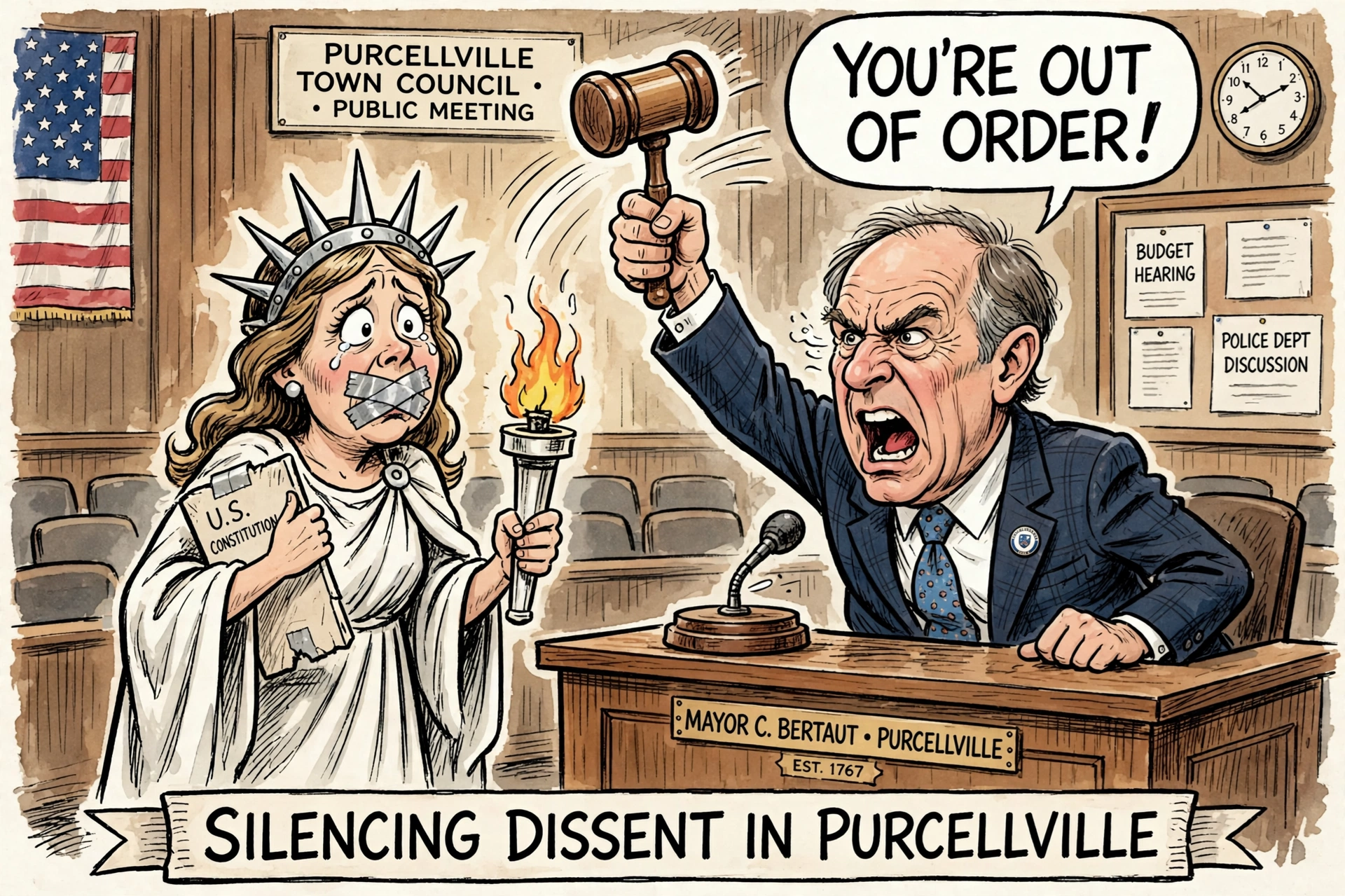
Which brings me to how the First Amendment has been handled by Mayor Bertaut over the past 18 months. During public comment, the First Amendment applies. Yet past agendas included rules stating that remarks must be directed only to the Mayor and the Council as a whole and comments to individual officials were prohibited. Preventing citizens from criticizing their local government is unconstitutional.The First Amendment doesn’t disappear because an elected official dislikes what is being said.
Here are a few concrete examples.
On September 9, 2025, I spoke about John Heather’s termination and was gaveled mid speech, along with other residents during their comments. That interruption is the only reason I ran a few seconds over, yet my mic was cut the moment time was up. I was crying at that point based on the content of my speech. Yes, the Mayor can end comments at the time limit, but gaveling someone in the middle of crying was unnecessary and humiliating. Other residents were gaveled as well, including one whose mic was cut simply for objecting to how I was treated. I had never met him before that night and I’ll always be grateful for him standing up for me.
There are many court cases out there regarding free speech during public comments.
One in particular, White v. City of Norwalk (9th Cir, 1990), the Court made it clear that discomfort, disagreement, criticism, or dissent is not grounds for silencing a speaker.
While removal of “any person who interrupts and refuses to keep quiet . . . or otherwise disrupts the proceedings of the Council” (Norse v Santa Cruz, 9th Cir, 2010) was deemed appropriate, the Court found in White “that discretion is not unlimited, and that rules may not be enforced in order to suppress a particular viewpoint”.
In Leventhal v. Vista Unified School District (SD Cal, 1997), The Court declares that the prohibitions on any criticism, “complaint or charge against an employee of the District” contained in Vista Unified School District Bylaw No. 9002, §§ B and C, violate the Plaintiffs’ rights secured under the First and Fourteenth Amendments to the United States Constitution. ”
The Mayor cannot discriminate based on viewpoint which is protected under the First Amendment. Meaning, it is not legally justified to tell citizens during their allotted public speaking time that they can’t criticize specific town council members. Criticism is protected speech. That’s not disruption. That’s democracy. And is backed by case law and precedent.
A second example is regarding the Mayor’s political social media account. On October 29th, 2025, he posted a Boil Water Advisory on his page. Comments were enabled. Two residents, including me, exercised our First Amendment rights and commented. Then comments were disabled, preventing additional criticism.
Precedents like Davison v. Randall (4th Cir, 2019), (which happened in Loudoun county) and Lindke v. Freed (SCOTUS, 2024) emphasize that officials acting in a governmental capacity cannot engage in viewpoint based restrictions on social media, including banning or blocking individuals solely due to those individuals holding opposing viewpoints. If a public official initially allows comments on a social media post, they must then moderate those comments in a viewpoint-neutral manner.
While an elected official may disable ALL commenting across the board equally for all users, disabling comments after they have been enabled and in direct response to certain viewpoints violates the First Amendment.
Elected officials hold power. And that power isn’t supposed to be utilized as a political weapon satisfying a leader’s own agenda. It’s a responsibility owed to every resident they represent.
The First Amendment wasn’t written to make leaders comfortable. It was written to hold them accountable.
Editor’s Note: It was immediately after Casey Chapman’s public comment that local resident Josh Shields was removed by Mayor Bertaut from the council meeting for verbally confronting the town attorney and mayor over the illegal silencing of Mr. Chapman’s microphone as shown in the video above. While this removal may have been proper under the provisions of “public disruption”, we believe that it is apparent that the previous actions taken by the mayor caused this emotional response.
This action sparked a larger effort and drive by local residents for transparent and proper governance, including the protection of First Amendment Rights during public comment. This collective effort became the foundation for the coalition behind the Citizens for Purcellville organization.
Following the September 9th meeting, the Mayor revised his behavior and stated meeting rules, likely following legal advice by the town on matters of First Amendment rights of public speakers.
Josh Shields is the named Executive Director of the Citizens for Purcellville PAC.
Leave a Reply